Multiple investors and 3D-printing industry insiders have indicated that Bambu Lab is close to completing a new funding round, with Tencent reportedly among the participants. The company’s valuation is rumored to reach up to US$10 billion.
Signals had surfaced earlier. On July 30, Bambu Lab announced a comprehensive partnership with Tencent Cloud, integrating Tencent’s Hunyuan 3D-generation model into MakerWorld, its 3D-modeling community.
Both sides have since denied the investment rumors.
1. Strong Market Visibility and Expanding Global Reach
According to GoodsFox’s advertising intelligence, Bambu Lab’s global website bambulab.com currently ranks #107,289 worldwide in overall web traffic.
The company is running digital advertising campaigns across 37 countries and regions, including the United States, Germany, Mexico, Japan, and Brazil.
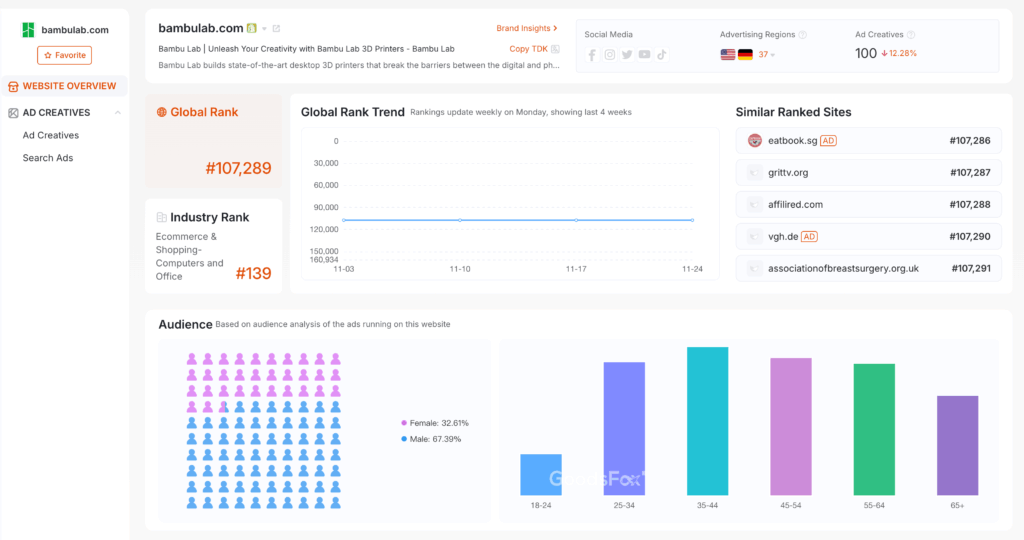
Key marketing insights from GoodsFox show:
-
🇺🇸 The United States has the highest ad volume among all regions.
-
🇧🇷 Brazil records the highest cumulative Google Search ad impressions, indicating strong organic and paid demand growth in emerging markets.
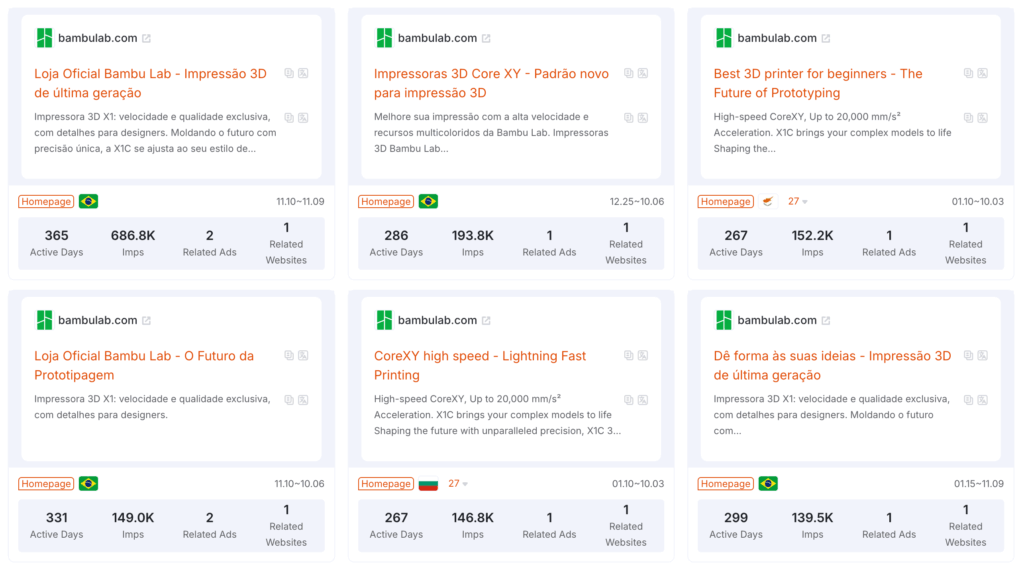
These metrics highlight the company’s aggressive go-to-market expansion and increasingly globalized consumer base—factors that support its rapid revenue and valuation growth.
2. Strategic Investors Circle the Emerging Global Leader
Tencent is already a shareholder in Creality, another major 3D-printing company now pursuing a Hong Kong IPO.
Bambu Lab, meanwhile, has become one of the sector’s most compelling unicorns.
Research from Soochow Securities estimates that Bambu Lab generated RMB 5.5–6 billion (US$760–830 million) in revenue last year, with nearly RMB 2 billion in net profit.
Media reports also indicate over 1.2 million units shipped, giving the company a 29% global market share.
Its last public financing round in 2023 included investors such as Matrix Partners China, Temasek, True Light Capital, and 5Y Capital.
3. A Rare Business Model Advantage Driving Exponential Growth
Bambu Lab’s rapid rise stems from a rare combination:
a fast-growing market and a product two generations ahead of competitors.
According to Precedence Research, the global 3D-printing market reached US$24.61 billion in 2024, with an expected 18.5% CAGR through 2034—a decade of hyper-growth.
Before Bambu Lab entered the scene, desktop 3D printers were dominated by open-source hardware and required heavy manual adjustments.
Bambu Lab transformed the category with:
-
Automatic bed leveling
-
Fully enclosed printer design
-
A breakthrough multi-color AMS system
These features solved the industry's two biggest bottlenecks—low speed and complex operation—boosting speed by several multiples and enabling true one-click printing for beginners.
An industry veteran noted:
“Bambu Lab accelerated the adoption of multi-color printing overnight. Competitors needed two full years to replicate its high-speed and multi-color capabilities—two years in which Bambu Lab surged ahead.”
Another expert commented:
“Since its founding, Bambu Lab has barely made a strategic mistake. It feels like the founder, Tao Yea, already knew all the answers.”
4. Setting Off a Global Arms Race in Consumer 3D Printing
Bambu Lab’s success triggered a full-scale technology and ecosystem arms race.
Nearly every mainstream manufacturer has since introduced high-speed models and begun experimenting with multi-color printing systems inspired by Bambu Lab’s AMS.
The broader impact is industry-wide:
desktop 3D printing is rapidly shifting from tinkerer hobby to household utility, powering children’s school projects, home DIY, personalized gifts, and more.
5. Massive Penetration in B2B and Enterprise Markets
Bambu Lab also dominates professional and commercial usage.
The company estimates that over 70% of global 3D-printing farms operate its P1 series printers.
Media visits show many hardware companies keep Bambu Lab devices in-house for rapid prototyping, demo creation, and parts testing.
6. DJI Enters the Arena, Intensifying Industry Competition
As the market grows more lucrative, competition is accelerating.
The most notable challenge comes from DJI, the former employer of Bambu Lab’s founder.
DJI recently confirmed an investment in SmartBot, a 3D-printer manufacturer, stating:
“The investment aligns with DJI’s commitment to innovative consumer hardware and our confidence in the long-term potential of 3D-printing technology.”
SmartBot also launched Nexprint China on November 10—an open 3D-model aggregation platform integrating Thingiverse, Printables, and MakerWorld—a direct competitive play against Bambu Lab’s growing community ecosystem.
7. The Future Battle: Software, Cloud Services, and Ecosystems
The next phase of competition will extend beyond hardware specs.
Key battlegrounds include:
-
Software reliability & ease of use
-
Cloud ecosystem and file-sharing capabilities
-
Filament and materials convenience
-
User onboarding and learning curve
The fight for leadership in global 3D printing is just beginning—and long-term winners will be determined by their ecosystem strength as much as their hardware innovation.
