Instead, it is expanding the types of advertisers it serves.
1. TikTok Is Shifting Toward Full-Funnel Advertising
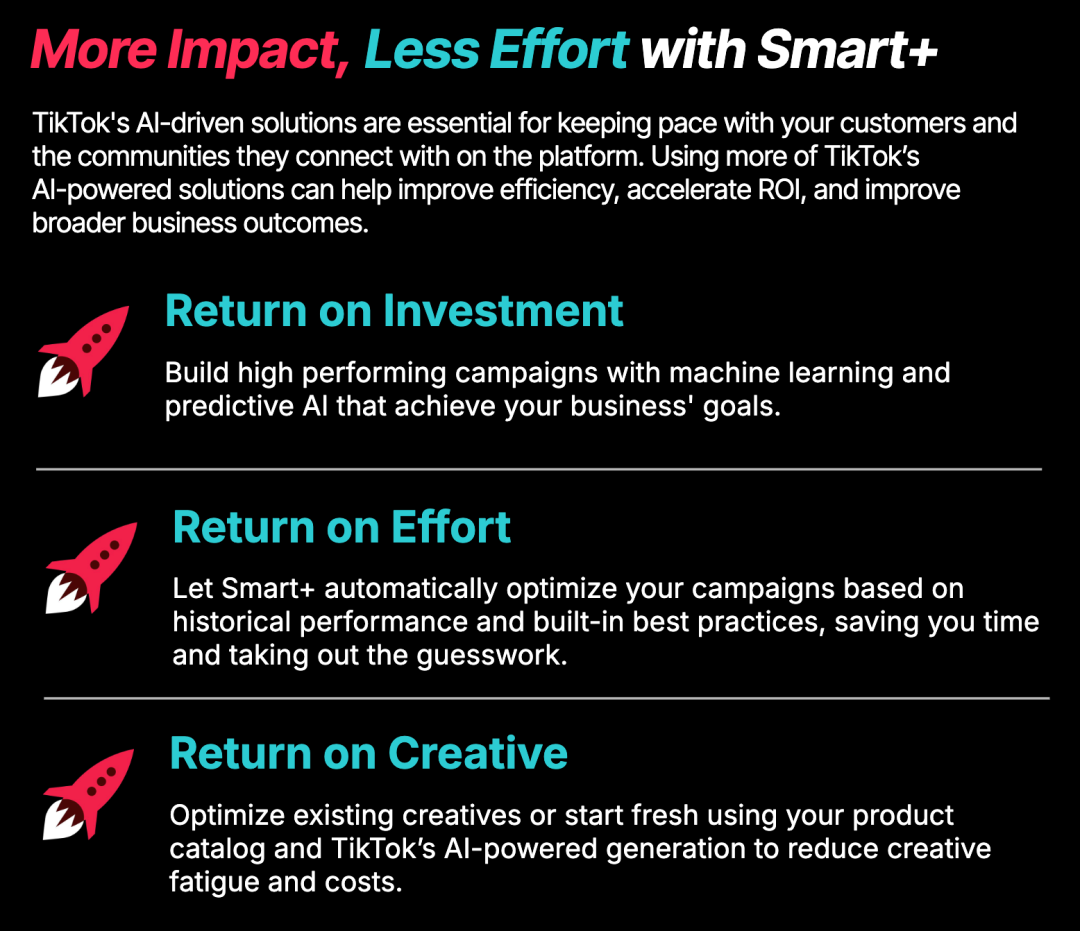
On the media buying side, TikTok continues to strengthen its Smart+ AI ad solutions.
Audience targeting, bidding, placements, and optimization are now unified into one intelligent system.
Advertisers only need to define goals and budgets.
The algorithm handles execution.
This marks a clear move toward automation-first performance marketing.
Source:TikTok for Business
2. Symphony Pushes Creative Automation Further
TikTok also launched Symphony, an automated creative toolset.
A single asset group can be broken down and recombined into multiple versions.
Formats vary by pacing, aspect ratio, and call-to-action.
Creative optimization continues automatically based on delivery performance.
As a result, execution efficiency is shifting to algorithms. Advertisers can focus on messaging, content strategy, and landing page conversion.
3. Identity Rules Are Changing for Ads
TikTok is also redefining ad identity.
By 2026, Custom Identity will be phased out. All new ads must be tied to an official account. This change is part of the TikTok F.I.R.S.T. framework.
Source:TikTok for Business
UGC content is directly affected.
Some creator content must now connect to brand accounts through Spark Ads or authorization.
The upside is content asset retention. UGC can now live longer as brand-owned media.
The downside is reduced exposure for unaffiliated creator posts.
4. TikTok Is Expanding Into New Industries
This year, TikTok introduced TikTok Travel Ads.
The goal is to attract travel platforms, airlines, hotel groups, and destination marketers.
Lifestyle brands with long consideration cycles are also included.
Travel Ads focus on structured content for trip planning.
Destinations, hotels, flights, and itineraries are presented in content-first formats.
Users can explore, save, or jump directly to external booking pages.

Source:TikTok for Business
For high-ticket and long-cycle industries, TikTok is becoming viable.
5. Attribution Is Becoming More Sophisticated
TikTok also updated its performance measurement guidance.
The platform now promotes Attribution Analytics, using combined attribution models.
Advertisers are encouraged to compare:
-
Different click and view attribution windows
-
Click-based and view-based attribution together
-
TikTok performance alongside other paid channels
The goal is to understand TikTok’s role in the user journey.
Is it first touch, interest reinforcement, or conversion assist? This marks a shift from last-click thinking to path-based attribution analysis.
