Some legacy accounts saw volatility. Others reported clear performance gains.At the core is a fundamental shift in how ads are matched to users.Meta has upgraded its recommendation engine.
The platform moved from traditional vector dot-product matching to a neural network that understands user–content interaction intent.
This change reshapes how targeting, creatives, and account structure work together.
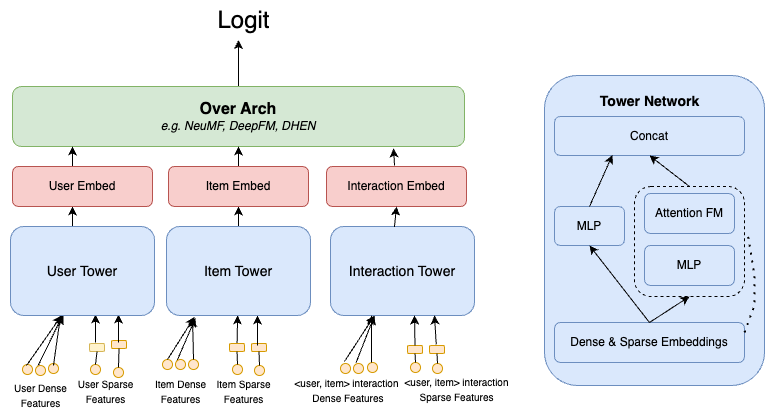
Source:《Hierarchical Structured Neural Network: Efficient Retrieval Scaling for Large Scale Recommendation》
1. From Interest Matching to Intent Understanding
Under the new architecture, Meta no longer evaluates users and ads in isolation.
It introduces an interaction layer that predicts whether a user is likely to act on a specific creative.
As a result, the marginal value of pure “interest” or “tag-based” targeting has declined.
The new delivery logic can be understood through four core mechanisms.
-
Creative is Targeting
Creatives are no longer just execution.
They are now a primary targeting signal.
The system extracts complex interaction features from ad content itself.
Creative vectors are combined with user behavior signals during the retrieval stage.
This allows Meta to predict match probability based on how users engage with specific creative styles, not just declared interests.
-
Consolidation
Hierarchical neural networks require dense and continuous data.
Over-segmenting ad accounts dilutes signal quality.
This weakens the model’s ability to learn interaction patterns.
Meta’s system now favors fewer, well-structured campaigns with consistent feedback. Sparse, label-heavy setups underperform in this framework.
-
Broad
With Hierarchical Structured Neural Networks (HSNN), Meta can efficiently retrieve from massive candidate pools.
This makes broad targeting not only viable, but often optimal.
Overly strict limits on age, gender, or interests may block high-potential conversion paths. The model performs best when allowed to explore.
-
Multi-style
Different creative styles map to different embedding clusters.
Each cluster represents a distinct traffic pool.
Running multiple creative styles in parallel helps the system build strong matches across clusters.
This improves delivery stability and reduces performance volatility over time.
2. WhatsApp Ads Officially Launch
Meta has also rolled out ads on WhatsApp.
Ads will appear in the Updates tab and channel-like surfaces.
Delivery is based on basic signals such as location, language, followed channels, and engagement behavior.
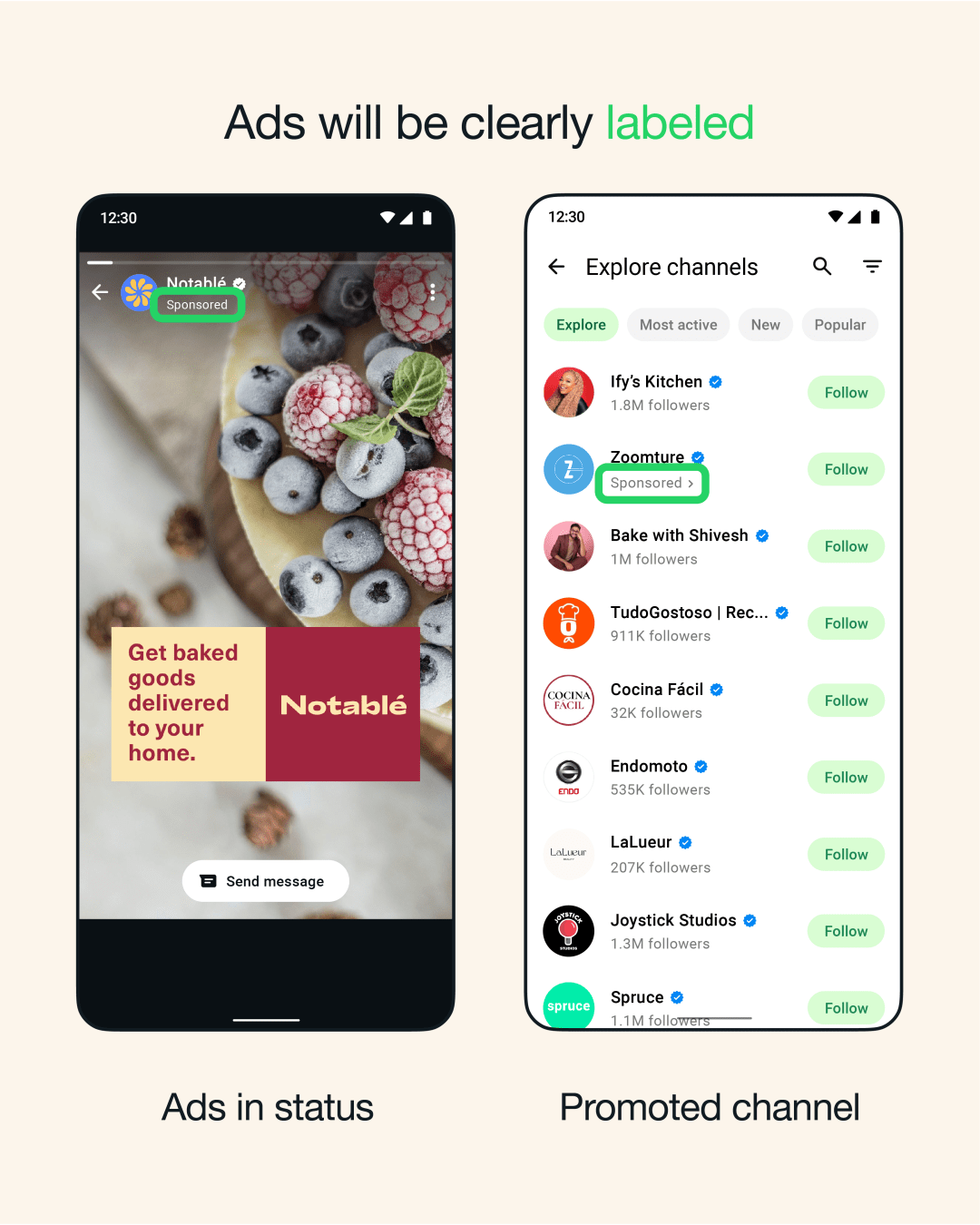
Source:WhatsApp Help Center
According to Meta, WhatsApp ads follow a privacy-first design. Private messages and calls are not accessed.
Optimization relies only on preferences linked through the Meta Account Center.
