1. Why the Middle East Is a Unique Market for War Strategy Games
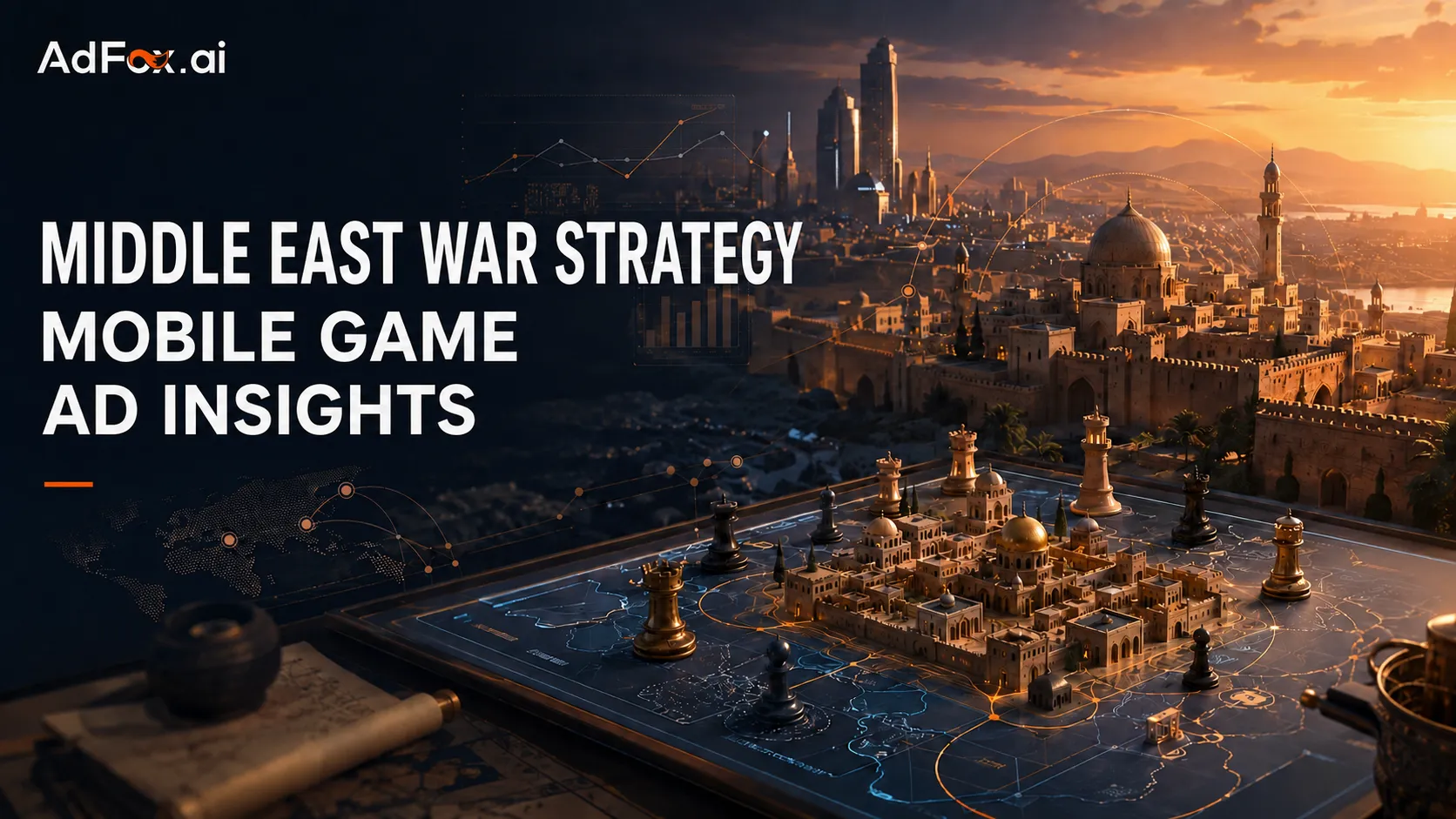
War strategy mobile game ad activity in the Middle East far exceeds other categories. This isn’t a general preference difference — AdFox observable ad data shows that war strategy/SLG games in the Middle East have campaign sustainability (top creatives running over 1,000 days) and single creative impression volumes (over 5 million) that significantly lead other categories.
Behind this category concentration lies a unique factor: Middle Eastern users’ special preference for “protection” and “responsibility” narratives. In the US and Europe, strategy game acquisition hooks center on “conquest,” “plunder,” and “thrill”; in the Middle East, the highest-performing acquisition narrative is “save your people,” “protect your city.” This narrative preference difference directly influences strategy game creative directions, campaign methods, and even localization requirements in the region. Understanding this unique factor is the key prerequisite for evaluating Middle East strategy game campaign opportunities.
This article analyzes category hotspots, core creative patterns, localization requirements, and channel preferences based on AdFox war strategy mobile game ad campaign data from the Middle East in the first half of 2026, using the region’s highest-volume strategy advertiser Lords Mobile: Kingdom Wars as the core case study.
2. Why War Strategy Ad Activity Far Exceeds Other Categories
The Middle East’s mobile game ad activity distribution differs significantly from other emerging markets. In Brazil, the most active categories are football and casino; in Southeast Asia, casual and hyper-casual dominate. But in the Middle East, war strategy games firmly occupy the top position in ad activity volume.
Core driver: Protection narrative preference. Middle Eastern users have a natural consumption preference for “protection” and “responsibility” narratives — “save your people,” “defend your city” convert far better in the Middle East than “conquer enemy nations,” “plunder resources.” This preference is directly linked to the high value Middle Eastern culture places on family and community responsibility.
Category data evidence:
| Category | Observable Activity Level | Representative Features |
| War strategy/SLG | Extremely high | Top creatives running over 1,000 days, single creative impressions over 5M |
| Casino/poker | High | Deep localization, integrating Islamic cultural visual elements |
| Battle royale shooting | Moderate-high | Deep IP crossovers (Dragon Ball Z has a massive fan base in the Middle East) |
| Social quiz | Moderate | Family gathering entry point, primarily UAE-focused |
| Casual puzzle | Moderate | Multiple creatives running over 100 days, moderate volume but sustained |
War strategy’s ad activity volume and campaign sustainability both far exceed other categories, indicating sustained real demand — not a short-term burst.
3. Top Game: Lords Mobile: Kingdom Wars Campaign Strategy Analysis
Lords Mobile: Kingdom Wars (IGG SINGAPORE PTE. LTD.) is currently the Middle East market’s highest-volume strategy SLG advertiser. Its campaign data provides an important window into observing the region’s strategy category competitive landscape.
Campaign sustainability. Top creatives have campaign durations of 1,235 days and 1,015 days, with single creative impressions of 5,028,113 and 2,446,723 respectively. This ultra-long campaign cycle (over 3 years) indicates IGG has extremely strong long-term confidence in the Middle East strategy category — no advertiser would sustain over 3 years of budget on an ineffective creative direction. Meanwhile, the same creative is linked to 100 ad variants, meaning it’s extensively reused across different regional and audience targeting combinations with extremely high deployment efficiency.
Creative strategy. Its Middle East creative core is the city building + save your people narrative, with Arabic ad copy “Expand the city to save your people.” The visual arc runs from city-under-attack crisis scenes to post-building expansion prosperity — a complete “crisis → building → saving” narrative arc. This is completely different from its US and European creative strategy: in those markets, Lords Mobile uses tiger fights, physics destruction, cartoon animations and other “thrill/curiosity”-oriented creatives running only 1-5 days.
Publishing model. IGG adopts an “official direct publishing + regional agency” dual-track publishing model in the Middle East. Gamota serves as the publishing agent for specific Middle East channels, with creatives labeled as “Lords Mobile – Gamota,” indicating IGG leverages local publishing partners to enhance Middle East channel penetration and localization adaptation capability.
Insight for other strategy game teams: Lords Mobile’s Middle East success isn’t because it’s “the best strategy game” — its success lies in precisely matching Middle Eastern users’ content preference for protection narratives. The same game acquires users with “save your people” narrative in the Middle East and “conquer kingdoms” narrative in the US and Europe. If your strategy product can also do creative adaptation in the “protection/building” narrative direction, the Middle East may be more suitable for focused campaigns than your home markets.
4. Ad Creative Analysis
Core Creative Pattern 1: City Building + Save Your People Narrative
This is the highest-share creative type in the Middle East strategy category, and also the most effective pattern.
Core logic: Middle Eastern users have a clear consumption preference for “protection” and “responsibility” narratives. The city building + save your people creative format transforms strategy gaming’s core experience — protecting citizens, building a homeland — into “responsibility-driven action impulse,” rather than the “conquest-driven battle impulse” common in the US and European markets. Lords Mobile’s highest-performing Middle East creative uses Arabic ad copy “قم بتوسيع المدينة لإنقاذ شعبك” (Expand the city to save your people), directly upgrading “download the game” behavior into “save your city” behavior.
Key difference from US/European strategy creatives: Strategy game creatives in the US and Europe prefer “conquest and plunder” narratives (attack enemy castles, plunder resources, dominate the world) or “thrill and decompression” narratives (tiger fights, physics destruction, reversal triumph). Middle Eastern markets prefer “protection and building” narratives — users care more about “is my city safe, are my people protected” rather than “how to conquer more territory.”
Key execution points:
- The narrative starting point needs to be “crisis/threat.” Middle Eastern users need to first feel “the city is under attack, the people need saving” before generating protection impulse — creatives that directly showcase building results perform worse than the complete “crisis → building → saving” narrative arc.
- Building achievement display needs before-and-after contrast. From “ruined shelter” to “prosperous city” comparison works better in the Middle East than simply showing a grand city — contrast generates achievement satisfaction, and achievement satisfaction reinforces the “I achieved protection” fulfillment.
- Arabic copy isn’t optional — it’s essential. Lords Mobile’s high-impression Middle East creatives all contain Arabic ad copy, indicating local language is an indispensable acquisition element in the Middle East strategy category.
Core Creative Pattern 2: Long-Term Brand Placement Creatives
This is a creative strategy unique to the Middle East strategy category — it essentially doesn’t exist in the US and European markets.
Core logic: Top advertisers in the Middle East strategy category adopt a “long-distance jogging” campaign strategy, rather than the “short sprint” approach common in the US and Europe. Lords Mobile’s top Middle East creatives have campaign durations of 1,235 days and 1,015 days, with the same creative linked to 100 ad creative variants (reused across different targeting combinations). This means in the Middle East, a proven effective creative can run continuously for over 3 years, accumulating impressions — while hit creatives in the US and European markets typically run only 1-5 days with high daily impressions but extremely short lifespans.
Campaign strategy comparison:
| Dimension | Middle East Market | US/European Markets |
| Creative lifespan | 1,000+ days | 1-5 days |
| Daily impressions | 2,000-4,000 | 300,000-360,000 |
| Linked creative variants | 100 | 6-15 |
| Campaign logic | Long-term stable placement | Rapid testing + iterative pruning |
Key execution points:
- The Middle East market doesn’t require frequent creative swaps. Once you find an effective creative direction (especially protection narrative type), it can run long-term without needing weekly creative changes like you would in the US or Europe.
- “Same creative, multi-dimensional reuse” is the core efficiency strategy for Middle East campaigns. One city building creative can be reused across different regional targeting (Saudi, UAE, Egypt, etc.) and different audience targeting (light players, veteran strategy players, etc.), linked to 100 ad variants.
- Brand creatives need to balance “long-term placement” with “new creative testing.” Lords Mobile simultaneously maintains 2 brand placement creatives running 1,000+ days and many 2-day test creatives — 2-day tests validate effectiveness, then good creatives enter long-term campaigns.
Core Creative Pattern 3: Localized Cultural Adaptation
Localization in the Middle East strategy category isn’t just “translate to Arabic” — it requires comprehensive adaptation from narrative logic to visual symbols.
Core logic: The core of Middle East localization isn’t language itself — it’s “values pivot.” Strategy creatives in the US and Europe are built around “conquest/plunder/thrill”; the Middle East market needs to pivot to “protection/responsibility/building.” This pivot affects ad copy wording, visual emotional tone, and even conversion trigger points.
Lords Mobile’s Middle East localization features:
- Ad copy shifts from “conquer the world” to “save your people.” The core appeal of Arabic creatives is “expand the city to save your people,” rather than the global version’s “conquer kingdoms” or “dominate the world.”
- Visual style shifts from “exaggerated cartoon” to “realistic building.” The Middle East market prefers realistic city building interface displays, rather than the cartoon animal conflict animations (tiger fights, physics decompression, etc.) common in US and European strategy creatives.
- Conversion trigger shifts from “thrill peak” to “achievement satisfaction.” Creatives in the US and Europe trigger download impulse at battle victory moments; Middle East creatives trigger “I can build a city like this too” action impulse after city expansion achievement displays.
Key execution points:
- Arabic is the foundation, but values pivot is the core. If your Middle East creative only translates English ad copy into Arabic while keeping the “conquest/plunder” narrative logic, performance will be far worse than pivoting the narrative to “protection/building.”
- Visual style needs to match Middle East preferences. Middle Eastern users prefer realistic, moderate, restrained visual expression — avoid overly exaggerated cartoon animations or violent conflict imagery.
- UI layout needs Arabic reading direction adaptation. Arabic reads right-to-left; ad visual information bar positions need mirror-flip adaptation.
5. Middle East Strategy Game Channel Preferences
| Channel | Fit Creative Types | Characteristics |
| Facebook/Instagram | City building, long-copy protection narrative | High Middle East user penetration, primary acquisition channel |
| YouTube | Brand long-term placement, extended building showcase | Middle East users need brand trust, YouTube share prominent |
| TikTok | Lightweight fun creatives, incremental testing | Rapidly growing, suited for lightweight packaging creatives |
| Snapchat | Short vertical creatives | Leading Middle East penetration, top advertisers haven’t yet heavily covered |
| AdMob/AppLovin | Programmatic coverage of mid-light users | Supplementary traffic channel |
Channel adaptation core principle: The Middle East strategy category’s core channel combination is Facebook + YouTube. Facebook carries precisely targeted deployment of building and protection narrative creatives; YouTube carries brand long-term placement creatives — these two campaign logics together account for over 70% of the Middle East strategy category. For Middle East strategy campaigns, Facebook is the starting acquisition channel; YouTube is the brand placement channel.
6. Track Middle East Strategy Category Competition with AdFox
The Middle East strategy category’s competitive landscape is evolving. While Lords Mobile occupies the top position, new advertisers and new creative directions are continuously emerging. Whiteout Survival, Rise of Kingdoms, Evony, and other products also have significant Middle East campaign activity.
Through AdFox’s Ad Library and Top Apps, you can:
- Continuously monitor category ad campaign volume changes. Filter Middle East market active strategy creatives by category and region in Ad Library, observing category campaign volume trend changes. If new strategy advertisers begin large-scale Middle East campaigns, it may indicate category competitive landscape changes.
- Track top advertisers’ strategy changes. Through App Detail’s Advertising Timeline, continuously monitor Lords Mobile and other top advertisers’ creative update frequency and new creative directions. When you discover top advertisers adjusting creative strategy (such as shifting from protection narrative to other directions), you need to quickly decide whether to follow.
- Identify localization creative trends. Through Creative Overview, study category advertisers’ localization creative differences in the Middle East — language choices, narrative logic pivots, visual style adaptation — providing reference for your localization strategy.
- Assess category competition density through Top Apps. Filter Middle East region strategy rankings in Top Apps, evaluating category competition density changes. Frequent ranking changes indicate intensifying category competition.
7. Practical Recommendations
- If your strategy product has “protection/building” narrative potential, the Middle East deserves focused campaigns. War strategy’s ad activity volume and campaign sustainability both far exceed other categories. If your product can integrate “save the people,” “protect the city” narrative elements in creatives, the Middle East may offer better focused campaign opportunities than the US or Europe.
- Creative narrative pivot: from “conquest” to “protection.” Middle Eastern users have a clear preference for “save the people,” “defend the city,” “build the homeland” narratives. Don’t use the “conquest/plunder” logic common in US and European creatives for the Middle East — changing “conquer kingdoms” to “save your people” will significantly boost performance.
- Localization must include values pivot, not just language translation. Arabic is just the foundation. Changing ad copy from “dominate the world” to “save your people,” visual style from exaggerated cartoon to realistic building, conversion trigger from battle thrill to building achievement — these values-level adaptations are the core of Middle East localization.
- Facebook is the primary acquisition channel; YouTube is the brand placement channel. Over 70% of high-performing creative types in the Middle East strategy category depend on Facebook + YouTube. Facebook handles precisely targeted acquisition; YouTube handles brand long-term placement — this is the core channel combination for the Middle East strategy category.
- Campaign pacing: long-term stability over short sprints. The Middle East market doesn’t require frequent creative swaps like the US or Europe. Once you find an effective protection narrative creative direction, it can continuously run for hundreds of days or even over 1,000 — creative lifespan in the Middle East strategy category is far longer than in the US and Europe.
- Establish continuous monitoring. Use AdFox’s Ad Library and Top Apps monthly to track Middle East strategy category competitive landscape changes and competitor campaign adjustments, ensuring your creative direction stays aligned with category trends.
8. FAQ
Q: Is the Middle East strategy category only suitable for products like Lords Mobile?
A: No. Lords Mobile is the current top advertiser, but its success core is the match between “protection narrative + long-term campaigns,” not the product’s uniqueness. Whiteout Survival (post-apocalyptic survival), Rise of Kingdoms (multi-civilization strategy), Evony (city-building conquest) also have significant Middle East campaigns. If your strategy product can integrate “protection/building” narrative elements in creatives, the Middle East has campaign opportunities.
Q: Must Middle East creatives use “protection narrative” — can’t they use “conquest narrative”?
A: It’s not absolutely prohibited, but performance differences is significant. AdFox observable data shows high-impression Middle East strategy creatives predominantly use “protection/building” narratives; “conquest/plunder” narrative creatives generally convert worse in the Middle East than they do in the US or Europe. Recommendation: prioritize protection narrative for acquisition creatives; conquest narrative can serve as supplementary brand communication direction.
Q: How long should Middle East strategy creatives run?
A: Two campaign rhythms coexist in the Middle East strategy category: long-term brand placement creatives (running 1,000+ days, daily impressions 2,000-4,000) and test creatives (running 2 days to validate effectiveness before deciding on scaling up). For teams newly entering the Middle East, start with the 2-day testing model to validate creative direction, then shift to long-term campaigns once an effective direction is found.
Q: Must I use Arabic voiceover/copy?
A: Observable ad campaign data shows Arabic copy performs far higher than purely English copy in the Middle East strategy category. Especially for ad copy, Arabic brings trust and immersion that English cannot replace. If you temporarily can’t produce entirely Arabic creatives, consider initially running Arabic ad copy + English/in-game visual format as a transitional approach.