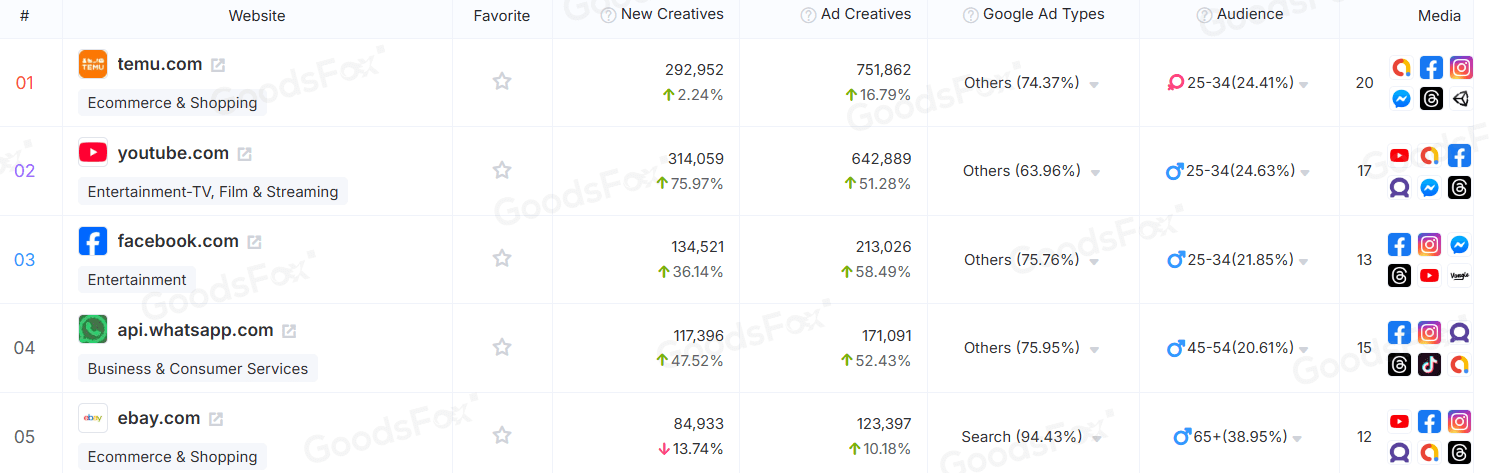
Weekly Ad Leaders: The 5 Most Active Websites in Global Advertising
Based on recent ad intelligence from GoodsFox:
Weekly Industry Highlights
-
A British Thermal Specialist Claims a 10-Minute EV Fast-Charge Breakthrough
-
Dassault Systèmes Pushes Real-Time Spatial Computing Into Automotive Design
-
Toyota Commits $912 Million to U.S. Hybrid Production Expansion
-
Why Private Equity Is Buying Restaurant Franchise Portfolios
-
The Key Restaurant Industry Trade Shows to Watch in 2026
-
Google Brings Hotel and Flight Bookings Into Its AI Mode
-
Government Shutdown Casts a Shadow Over Thanksgiving Air Travel
-
Health IT Spending Needs Stronger Operational Alignment
-
WellSpan Health Advances AI-Enabled Virtual Nursing
1. A British Thermal Specialist Claims a 10-Minute EV Fast-Charge Breakthrough
Hydrohertz, a UK thermal-management firm, has unveiled a charging breakthrough that could bring EV fast-charge times down to just 10 minutes. The company’s new Dectravalve system divides a battery pack into independently controlled thermal zones, allowing precise heating and cooling during high-power charging. In testing with a 100-kWh LFP pack, the hottest cell remained below 44.5°C, with a temperature spread of only 2.6°C across the pack—an unusually tight range for such rapid charging. Hydrohertz says the system is chemistry-agnostic and improves range, safety, and battery longevity, offering carmakers a pathway to faster charging without compromising durability. If validated in commercial vehicles, this could be one of the most significant advances in EV adoption since the introduction of high-power DC fast chargers.
2. Dassault Systèmes Pushes Real-Time Spatial Computing Into Automotive Design
Dassault Systèmes is positioning spatial computing as the next major leap in automotive engineering. Through deep integration with Apple’s Vision Pro, the company has brought its “3DLive” environment inside the 3DEXCITE platform, allowing engineers to interact with full-scale virtual twins using gestures, voice, and eye-tracking. Unlike traditional digital twin workflows that rely on a flat screen, Dassault’s real-time spatial environment supports instant iteration—adjusting a part or system in VR immediately updates the model for collaborators around the world. The platform also adds biometric eye-based authentication to safeguard sensitive IP. If widely adopted, this type of real-time immersive collaboration could significantly shorten development cycles and reduce the need for costly physical prototypes.
3. Toyota Commits $912 Million to U.S. Hybrid Production Expansion
Toyota is reinforcing its position in the hybrid market with a $912 million investment across five U.S. manufacturing plants. The plan includes new spending in West Virginia, Kentucky, Mississippi, Tennessee, and Missouri, and is expected to create more than 250 new jobs. A major portion of the funding will expand production of hybrid-compatible engines, transaxles, and electric motor components. Toyota’s Mississippi plant will begin building a hybrid-electric Corolla—the first such model manufactured in the U.S. This investment is part of the company’s broader $10-billion U.S. electrification strategy and signals Toyota’s ongoing belief that hybrid systems remain a crucial bridge technology for American consumers transitioning toward electrified vehicles.
4. Why Private Equity Is Buying Restaurant Franchise Portfolios
Private equity firms are aggressively purchasing restaurant franchise portfolios, driven by favorable interest rates and the sector’s stable cash flows. Instead of acquiring full brands, investors are buying up multi-unit franchise operators to build diversified, scalable portfolios with predictable revenue and lower operational risk. These acquisitions offer a blend of organic growth, geographic expansion, and bolt-on M&A opportunities. PE owners often bring advanced operational tools, stronger management systems, and expansion capital that individual franchisees typically lack. With the restaurant industry facing rising labor and supply-chain pressures, PE-backed operators are becoming increasingly influential in shaping the competitive landscape.
5. The Key Restaurant Industry Trade Shows to Watch in 2026
Restaurant Dive’s latest guide highlights nine major trade shows expected to shape the global dining industry in 2026. Events such as the Restaurant Finance & Development Conference, the International Franchise Association Annual Convention, MURTEC, and the Restaurant Franchising & Innovation Summit will cover themes including financing strategies, digital transformation, operational innovation, and franchising growth. These gatherings typically attract executives, investors, technology vendors, and suppliers, making them highly visible discovery channels for new solutions and emerging restaurant technologies. For operators planning long-term strategy or franchise expansion, these shows remain essential for spotting early trends.
6. Google Brings Hotel and Flight Bookings Into Its AI Mode
Google is integrating travel planning directly into its AI Mode, allowing users to book flights and hotels through a conversational interface. The new system, built around the company’s “Canvas” environment, lets travelers generate itineraries that automatically pull in maps, reviews, and pricing data. Users can refine their plans through follow-up questions, while partnerships with Booking.com, Marriott, Expedia, and Wyndham enable seamless in-app reservations. With these capabilities rolling out, Google is gradually positioning itself not just as a search engine but as a full-service travel planning platform—posing new competitive challenges to online travel agencies and metasearch sites.
7. Government Shutdown Casts a Shadow Over Thanksgiving Air Travel
The ongoing U.S. federal government shutdown is creating major disruptions ahead of the Thanksgiving travel period. Travel industry groups warn that cancellations and delays are increasing as air-traffic controller staffing levels continue to drop. Transportation Secretary Sean Duffy has publicly cautioned that air travel could “slow to a trickle” if staffing shortages worsen. Analysts estimate the shutdown could cost the economy billions of dollars, and travelers are already reporting reduced confidence in booking holiday flights. For airlines and travel platforms, the timing presents both operational and revenue challenges during one of the busiest travel weeks of the year.
8. Health IT Spending Needs Stronger Operational Alignment
A new commentary from Healthcare IT News highlights a widening gap between health-system IT spending and measurable operational outcomes. Many hospitals continue investing heavily in digital tools without establishing a clear framework to assess the return on those investments. Experts suggest using structured models such as the HIMSS Infrastructure Adoption Model to tie technology spending to clinical and operational KPIs. The article argues that successful digital transformation requires governance, cross-department coordination, and involvement from frontline care teams. Without this alignment, expensive IT platforms risk being underutilized, especially as value-based care reshapes how providers measure performance.
9. WellSpan Health Advances AI-Enabled Virtual Nursing
WellSpan Health is rapidly expanding its AI-enabled virtual nursing program, powered by computer vision and sensor-driven monitoring technology. The system, developed with Artisight, has significantly reduced sitter hours and unwitnessed patient falls while improving patient-experience metrics. Virtual nurses now manage more than 800 hours of clinical tasks each month, with more than 31% of admissions being monitored remotely. WellSpan is also exploring voice-activated documentation features as the next stage of deployment. The results demonstrate how AI can address staffing shortages, enhance patient safety, and streamline clinical workflows—offering a practical model for health systems seeking scalable digital-care solutions.
