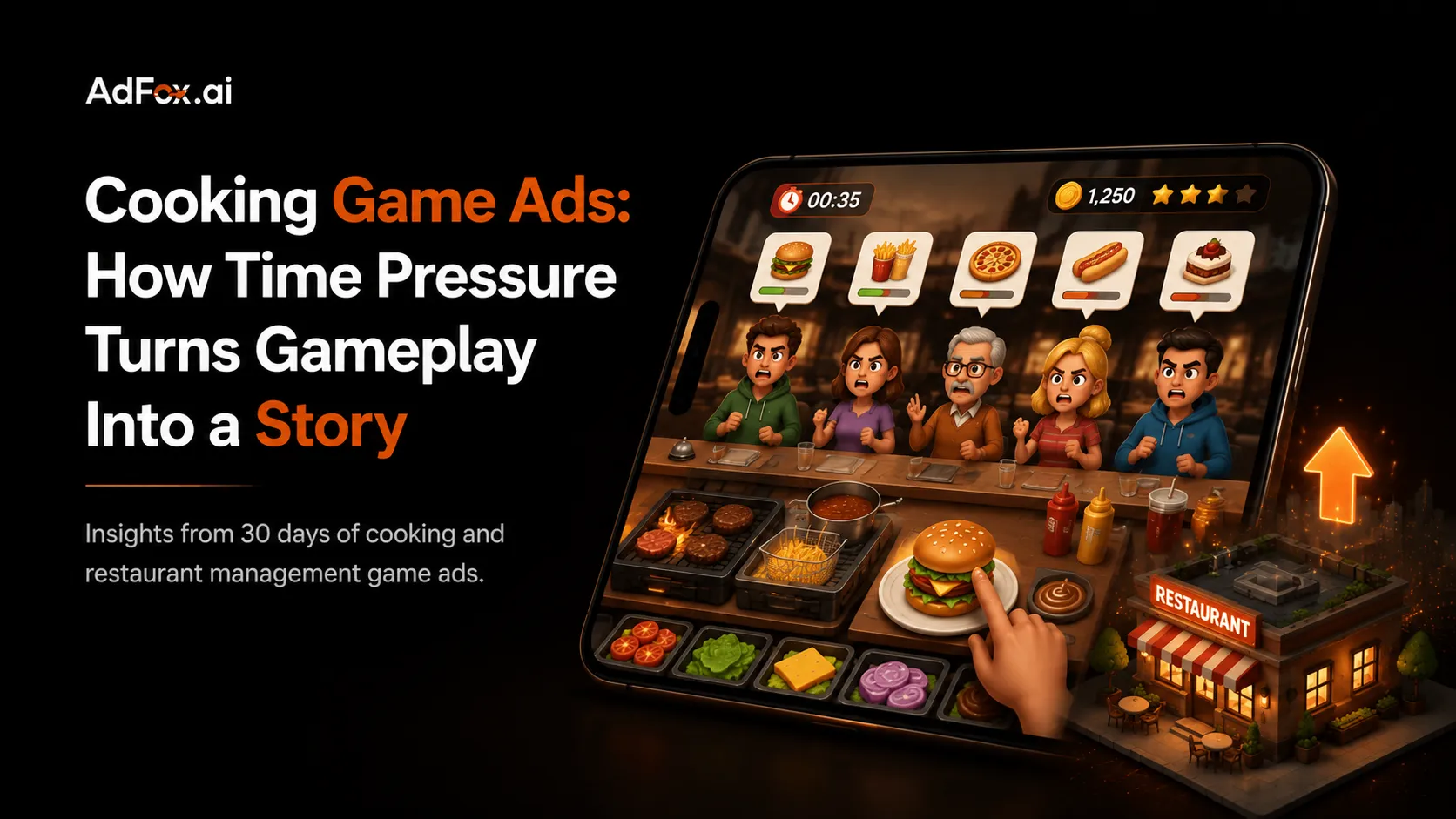
Key Takeaways
-
Cooking game ads rarely sell cooking alone; they sell the challenge of solving a visible problem under pressure.
-
Time pressure creates a simple narrative structure: demand → constraint → decision → feedback → progression.
-
Mistakes work because they create a “I can do better” reaction from viewers.
-
Characters, dialogue, and satisfying cooking sequences help repetitive mechanics feel like stories.
-
Strong creative variants change the situation while keeping the core gameplay promise consistent.
Cooking and restaurant-management games contain a built-in advertising engine. A customer is waiting. An order is incomplete. The kitchen is getting crowded. One wrong ingredient can turn a simple task into a visible failure.
In a recent 30-day review of cooking-game advertising based on AdFox’s creative data, this operational tension appeared repeatedly across gameplay videos, humorous voice-overs, customer dialogues, and live-action openings. The strongest recurring idea was not simply “make food.” It was “solve a small crisis before time runs out.”
That distinction helps explain why the category can turn basic taps, swipes, and upgrades into compact stories. Pressure supplies the conflict, the cooking action supplies the response, and a served order or improved restaurant supplies the reward.
What do cooking-game ads communicate in the first few seconds?
They commonly introduce a problem that can be understood without knowing the game. Orders begin to stack up. A customer asks for a specific combination. A player adds the wrong ingredient. Food burns, a station runs out, or an employee cannot keep up.
These scenarios work because the task is visually legible. Viewers recognize what “correct” should look like and can anticipate the consequence of a mistake. That makes the advertisement interactive in the viewer’s mind even before a download.
Key findings
- Order pressure and impatient customers create immediate, low-stakes tension.
- Mistakes invite viewers to believe they could perform the task better.
- Satisfying preparation sequences release the tension created by the opening.
- Dialogue turns repeated cooking actions into recognizable characters and situations.
- Coins, upgrades, restored spaces, and new stations extend the promise beyond one level.
- Creative variants often reuse the same problem while changing the dish, customer, error, or pace.
Why is a small failure such an effective hook?
A failed order is easy to understand and difficult to ignore. The bun is wrong, the topping is unwanted, the pan is burning, or the customer leaves dissatisfied. The viewer does not need a tutorial to see the mistake.
Failure also creates a competence gap. When the player on screen performs poorly, the viewer can imagine a better action. This “I would do it differently” response is particularly useful for casual-game advertising because it frames the interaction as accessible. The challenge looks solvable, not intimidating.
However, failure only works when it remains connected to the real game promise. If the ad presents a task, control system, or restaurant fantasy that the product does not meaningfully deliver, curiosity may be created at the cost of expectation. More durable creative uses failure to dramatize an authentic mechanic: prioritizing orders, selecting ingredients, managing time, or upgrading capacity.
How does time pressure create a complete narrative?
Time pressure gives ordinary actions consequence. Placing an ingredient is no longer a neutral tap; it is the step that may save an order. Restocking is not menu maintenance; it is the obstacle between a waiting customer and a completed dish.
AdFox summarizes this recurring structure as the **Kitchen Tension Loop**:
- Demand: a customer, queue, or goal appears.
- Constraint: time, ingredients, space, staff, or equipment becomes limited.
- Decision: the player chooses what to prepare or fix first.
- Feedback: the game shows success, error, impatience, or failure.
- Progression:** rewards unlock capacity, décor, staff, recipes, or the next restaurant.
The loop can fit into a short video because each stage is visually distinct. It also creates natural points for creative variation. One ad can emphasize a demanding customer, another a broken workflow, and another the satisfaction of a perfect service sequence.
Why do customer conversations appear so often?
Dialogue gives personality to a repetitive system. “No mustard,” “five cupcakes,” or “why is my order taking so long?” turns an icon above a customer’s head into a social interaction.
This format supports humor because the game can exaggerate familiar service situations. The demanding customer, overwhelmed worker, impossible customization, and synchronized queue are recognizable without requiring a complicated plot.
Dialogue also helps an advertisement sound like creator content. Commentary can question the game’s logic, complain about the customers, or narrate a chaotic shift. Instead of explaining features, the voice gives the viewer a point of view.
Creative teams can use three dialogue roles:
– Customer request: makes the objective concrete.
– Player reaction: supplies humor, frustration, or confidence.
– Observer commentary: invites the audience to judge what is happening.
The visual action should still carry the meaning. Dialogue works best as an amplifier, not as the only way to understand the scene.
What makes satisfying cooking footage valuable?
Pressure is only half of the category’s appeal. Cooking games also offer order, rhythm, and completion. Ingredients move into place, food changes state, plates fill, and clear feedback confirms a correct action.
These sequences can create a form of visual satisfaction similar to process videos. Consistent timing, readable motion, sound effects, and clean feedback make the task feel controlled. The viewer experiences a release from the chaos introduced earlier.
This tension-and-release rhythm gives creative teams several openings:
– start chaotic and end with a perfect service flow;
– begin with a mistake, then demonstrate the correct sequence;
– show an empty or damaged restaurant, then reveal an upgraded space;
– contrast a slow station with a faster, improved one.
The result is more than a gameplay demonstration. It is a miniature recovery story.
Which creative formats fit cooking and restaurant games?
Gameplay with humorous voice-over
The gameplay remains central while the narration gives the player or customers a personality. This format is flexible and relatively easy to vary.
Customer–staff micro-scene
The ad begins with a request or complaint and turns it into a playable task. This is useful when customization and service are important parts of the fantasy.
Live action to gameplay
A real kitchen problem or creator reaction establishes the situation before the video transitions into the game. The connection should be direct enough that the opening does not feel detached from the product.
Satisfying process montage
Preparation, assembly, serving, and reward appear in a rhythmic sequence with minimal dialogue. This is useful for communicating tactile pleasure and pace.
Restaurant transformation
The ad expands from individual dishes to restoration, decoration, staffing, or unlocking new locations. This communicates long-term progression rather than a single minigame.
What do three current cooking-game cases reveal?
The category becomes more useful when the recurring patterns are compared at product level. Three games visible in the recent 30-day period use different creative routes to make restaurant play recognizable.
Case 1: Cooking Fever turns familiarity into the opening hook
Cooking Fever is a Nordcurrent time-management game built around preparing dishes and serving customers across multiple restaurants. In the observed creatives, the game does not always begin by teaching the cooking system. Several ads first use a creator-style reaction or a nostalgic prompt about playing the game on a parent’s phone, then move into recognizable gameplay.
The core sequence shows customers arriving, order bubbles appearing, and the player managing several dishes or cooking stations under time pressure. The human introduction creates familiarity; the gameplay supplies proof that the remembered restaurant loop is still central. End frames return to the Cooking Fever name and an app-store action.
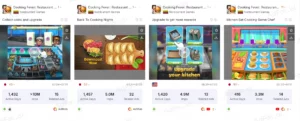
What marketers can reuse: an established game does not have to reintroduce itself as if nobody knows it. Familiarity can become the hook, but the ad should still reconnect that memory to current gameplay. Nostalgia attracts attention; representative play tells viewers what they will actually do.
Case 2: Kitchen Scramble uses a recurring chef as a visual anchor
Kitchen Scramble 2: World Cook is operated by Garden City Games. Its observed advertising repeatedly uses its red-haired chef character, food close-ups, and restaurant or food-truck settings. The character remains recognizable while the surrounding situation changes—from different dishes and service locations to seasonal or event-related scenes.
Rather than relying on a single anonymous gameplay clip, the campaign gives viewers a recurring host. Food photography or highly detailed dish imagery creates appetite appeal, while gameplay and restaurant scenes reconnect the image to the management fantasy. The end frame commonly reunites the chef, game identity, and download path.
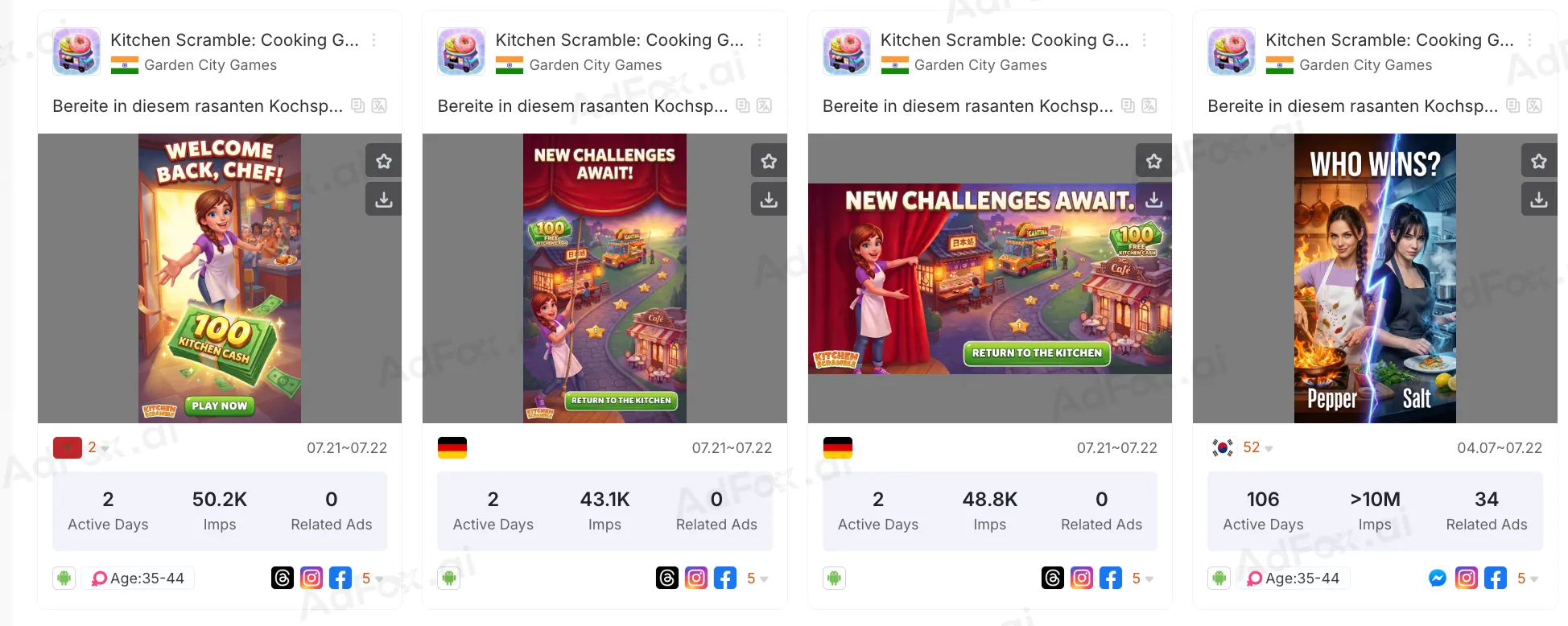
What marketers can reuse: a recurring character can hold a varied creative system together. New dishes, events, and settings provide novelty, while the same chef preserves recognition. The important safeguard is to keep enough representative gameplay in the sequence so that food appeal does not replace the product promise.
Case 3: Good Pizza, Great Pizza lets the core interaction do the selling
Good Pizza, Great Pizza is developed by TapBlaze. The observed examples take a more gameplay-led route: a customer places an order, the player chooses toppings, the pizza is baked and sliced, and the customer responds.
The hand-drawn customer dialogue and topping interface make the game identifiable without a separate live-action story. An unusual request or an ingredient decision supplies the tension; the completed pizza and customer reaction supply the feedback. Compared with creator-led or character-led packaging, the ad stays close to the actual interaction.
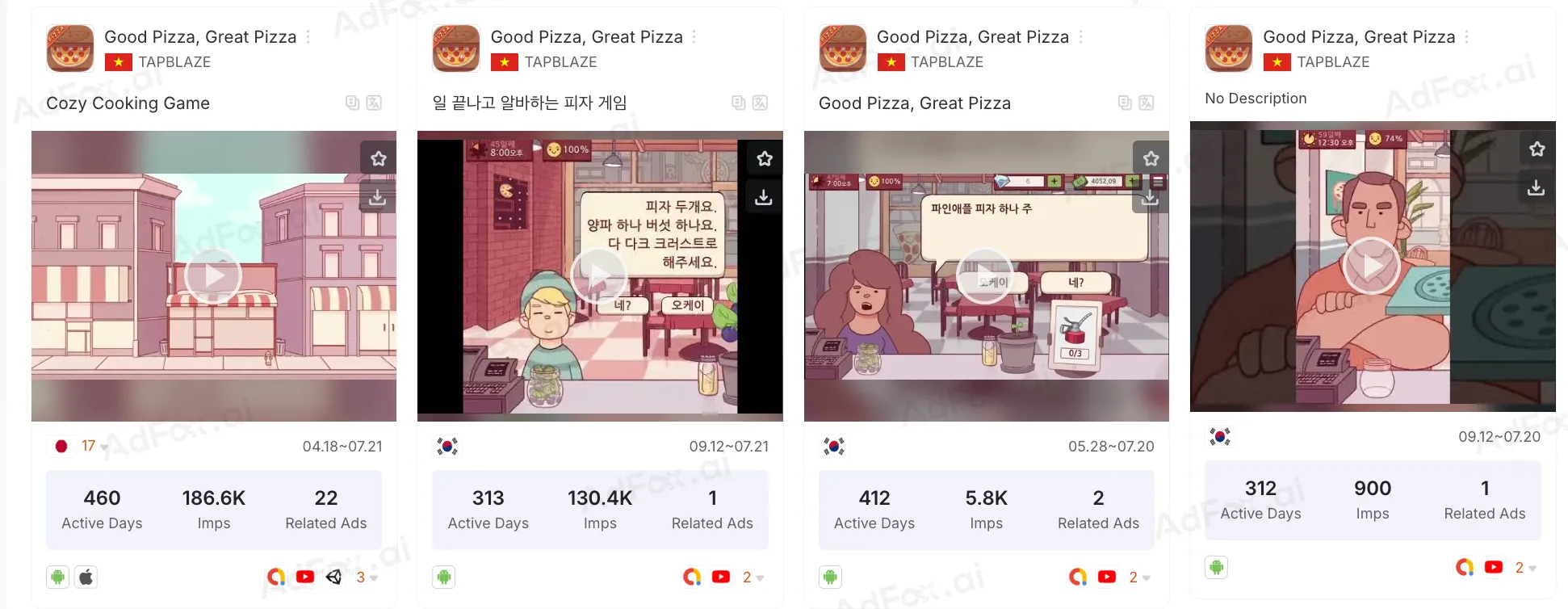
What marketers can reuse: when a game has a distinctive visual system and easily understood decisions, gameplay can function as both demonstration and narrative. The creative task is to select an order that creates a question quickly, not to cover every feature in one video.
How should the landing experience continue the ad?
The store page should confirm that the advertised loop belongs to the game. Screenshots and preview video can reinforce the dishes, restaurant setting, time-management system, characters, and progression shown in the creative.
Message continuity is especially important when an advertisement leads with a dramatic mistake or simplified interaction. The destination should broaden the promise honestly: show what the player does after the first order, what can be upgraded, and how the restaurant develops.
Useful continuity signals include:
- the same visual identity, characters, or restaurant environment;
- screenshots of actual cooking and service interactions;
- clear evidence of progression beyond the opening task;
- accurate descriptions of customization, cooperation, or management features;
- a preview that balances dramatic hooks with representative play.
Frequently asked questions
Why do cooking-game ads show players making obvious mistakes?
Visible mistakes are easy to understand and can trigger the viewer’s desire to correct them. The approach is most credible when the mistake reflects a real game mechanic.
Are satisfying gameplay videos enough on their own?
They can be, especially when the process is visually distinctive. Adding a clear goal or constraint often gives the sequence more narrative momentum.
Should ads focus on cooking or restaurant upgrades?
Cooking communicates the immediate interaction; upgrades communicate longer-term progression. Many campaigns benefit from connecting the two rather than choosing only one.
How can marketers research competitor cooking-game creatives?
Use AdFox to compare active ads, recurring hooks, dialogue patterns, gameplay presentations, and destination pages over a recent 30-day period. Group related variants before drawing conclusions from individual ads.
About AdFox
AdFox is an advertising intelligence platform covering games, apps, and websites across major media channels. It helps marketing and creative teams compare active advertising, identify repeated concepts, study competitor positioning, and turn market observations into more structured creative decisions.